The minute
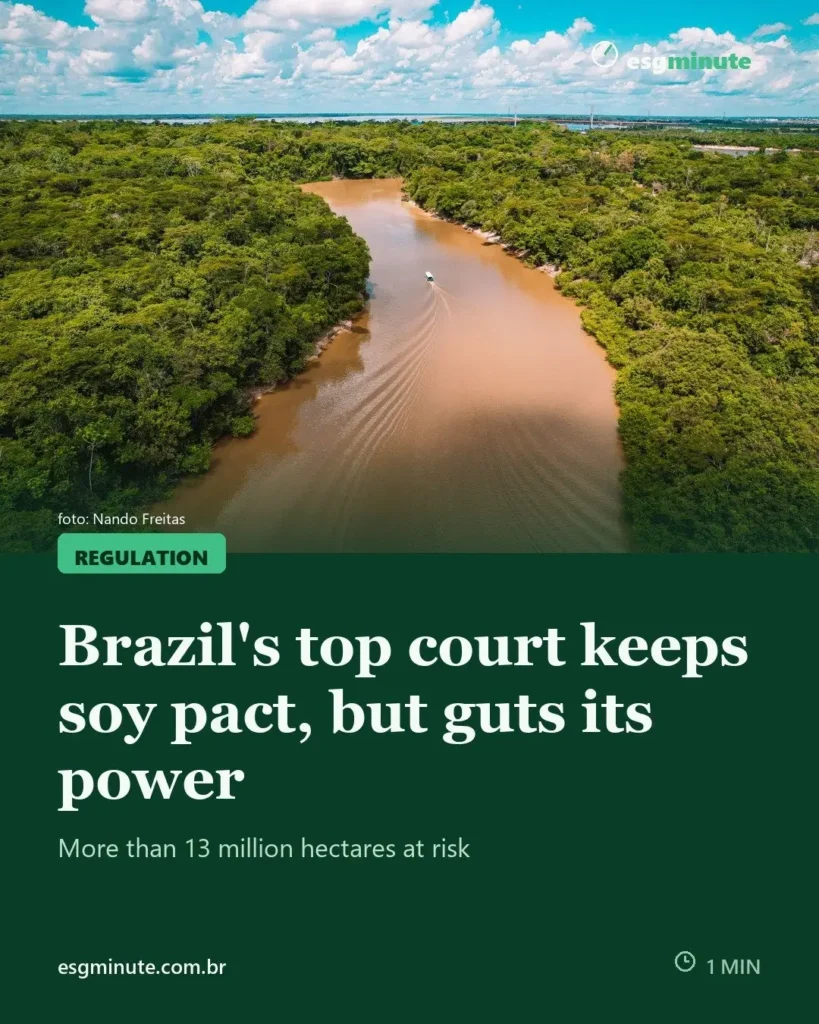
- Brazil’s Supreme Federal Court (STF) ruled the Amazon Soy Moratorium is constitutional, ending lawsuits seeking compensation over it
- The same ruling upheld state laws in Mato Grosso and Rondônia that deny tax benefits to companies that sign the moratorium
- A study cited in coverage of the ruling estimates the practical effect ends the moratorium as of 2024, putting more than 13 million hectares of Amazon vegetation at risk of conversion to agriculture
Why it matters: The Soy Moratorium has been one of the most cited voluntary supply-chain deforestation agreements globally; a ruling that keeps it legal on paper while letting states penalize signatories removes much of its practical enforcement power. The decision illustrates a broader tension in Brazil between federal environmental commitments and state-level agribusiness incentives, a dynamic that also shapes how credibly companies can claim deforestation-free soy sourcing going forward.
How the Soy Moratorium works
The Soy Moratorium is a voluntary agreement among grain traders and processors, organized through ABIOVE (the Brazilian Vegetable Oil Industry Association) and ANEC (the National Grain Exporters Association). Under its terms, signatories commit to not purchasing soy grown on land in the Amazon biome that was deforested after July 2006. The agreement was first signed in 2006 as a two-year commitment, renewed repeatedly, and made indefinite in 2016.
Enforcement relies on satellite monitoring. Brazil’s national space research institute (INPE) publishes annual deforestation data through its PRODES system, which maps clear-cut areas across the Amazon. Signatories cross-reference the coordinates of farms supplying them against PRODES maps. If a farm sits on land cleared after the cutoff date, the trader is supposed to refuse the purchase or drop the supplier from its approved list.
The moratorium does not cover the Cerrado biome, which produces a larger share of Brazil’s soy and has experienced significant land conversion of its own. It also does not cover indirect land-use change, where soy displaces cattle ranching, which then pushes deeper into forest. These limitations have been longstanding criticisms, but within the Amazon biome itself, the agreement is widely credited with reducing soy-driven deforestation after its adoption.
What the state laws actually do
The STF ruling did not simply validate the moratorium. It simultaneously upheld laws passed by the states of Mato Grosso and Rondônia that strip tax incentives from companies participating in the agreement. In Brazil’s tax system, states control the ICMS (a value-added tax on goods and services), and they routinely offer reduced ICMS rates or other fiscal benefits to attract and retain agribusiness operations. These state laws condition those benefits on non-participation in the moratorium.
The lawsuits that reached the STF originally argued that the moratorium constituted an irregular restraint on trade, because signatories collectively refused to buy from certain producers. The court rejected that argument, finding the moratorium lawful as a voluntary private agreement. But by also upholding the state-level penalty laws, the court created a legal environment in which signing the moratorium is permitted but financially punished.
Mato Grosso is the single largest soy-producing state in Brazil. A company operating there that signs the moratorium now faces a direct cost: the loss of state tax benefits that competitors who do not sign continue to receive. For a commodity business operating on thin margins, that cost can be decisive.
Practical consequences for soy buyers
For international buyers, particularly those sourcing soy for European markets, the ruling complicates compliance planning. The EU Deforestation Regulation requires importers to demonstrate that commodities (including soy) were not produced on land deforested after December 2020. The Soy Moratorium, with its earlier cutoff date and established satellite verification process, had served as a useful (if imperfect) layer of assurance for companies building due-diligence systems.
If major traders begin withdrawing from the moratorium to preserve their tax benefits in Mato Grosso, the monitoring infrastructure that the agreement supports could weaken. Individual companies would still need to conduct their own due diligence under EU rules, but the collective, industry-wide commitment to refuse deforested soy, and the shared data systems built around it, would lose participants.
The most common error companies make in this situation is treating the moratorium and regulatory due diligence as interchangeable. They are not. The moratorium is a collective market signal: traders agree together not to buy, which changes the economics of clearing land for soy. Regulatory due diligence, by contrast, is an individual compliance obligation. A company can pass its own due-diligence audit while the broader market signal collapses, because the audit only checks that company’s own supply chain, not what is happening across the industry.
What remains unresolved
The STF ruling does not prevent the federal government from passing legislation that would override state-level penalties. Whether that happens depends on political dynamics in Brasília, where the agribusiness caucus holds substantial influence in Congress. No such federal bill is currently advancing.
It is also unclear whether other soy-producing states will follow Mato Grosso and Rondônia in passing similar laws. If they do, the economic pressure on signatories would expand. If they do not, the moratorium could survive in a weakened form, binding only in states that do not actively penalize participation.
For companies that have built sustainability commitments around the moratorium, the immediate question is whether to remain signatories and absorb the tax penalty, or withdraw and rely solely on their own due-diligence systems. Neither option is costless. Staying in means paying more in a key producing state. Leaving means losing the collective enforcement mechanism and facing reputational scrutiny from buyers and civil society groups that view the moratorium as a benchmark.
The ruling, in short, did not kill the Soy Moratorium. It made participation expensive enough that the market may do so instead.
via ClimaInfo
There is no newsletter yet. Leave your email and you will hear first on the day there is one.