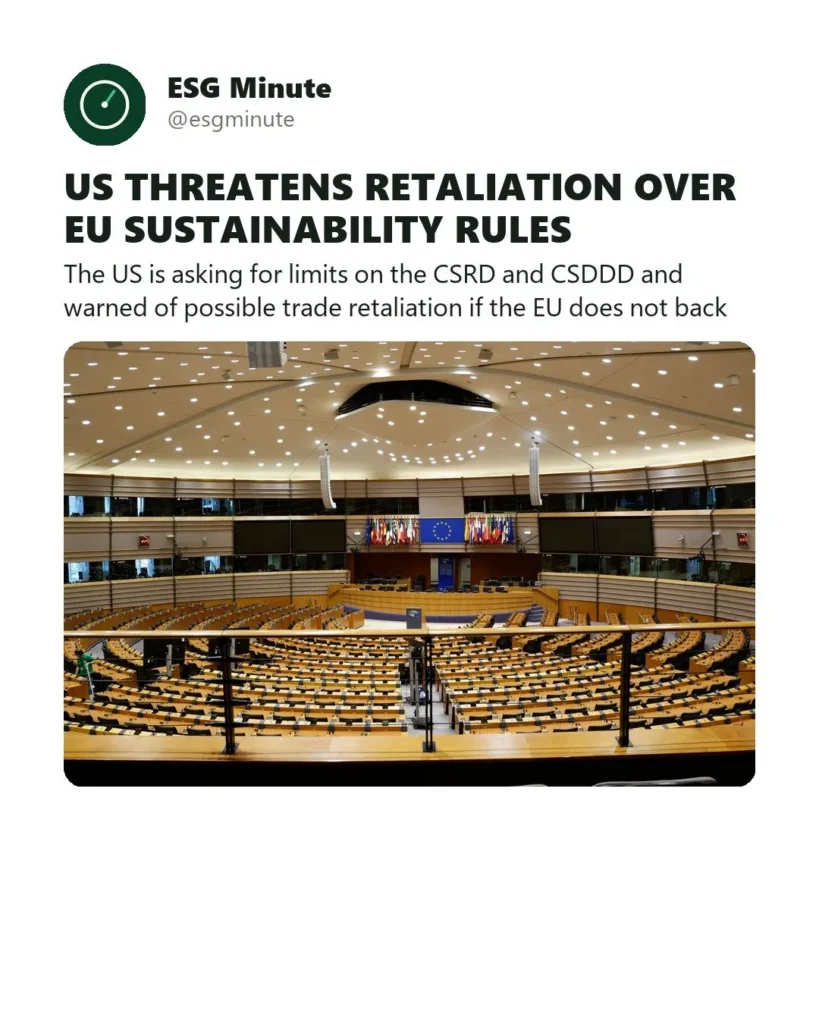
The minute
- The US government formally objected to the EU’s Corporate Sustainability Due Diligence Directive (CSDDD) and Corporate Sustainability Reporting Directive (CSRD), calling them an undue burden on American companies
- Washington is requesting significant limits on enforcement, in particular the extraterritorial scope of the rules and the “double materiality” reporting standard
- US officials warned of possible retaliatory trade action if the concerns are not addressed
- The comment letter was issued by the U.S. Mission to the European Union, with Ambassador Andrew Puzder publicly backing the demands
Why it matters
If the US follows through with trade retaliation, EU sustainability reporting rules stop being just a compliance question for companies and become a live point of transatlantic trade friction, which could pressure the EU to water down the very rules global companies have spent years preparing to comply with.
The CSRD and CSDDD already apply to many non-EU companies with sufficient revenue or activity in the EU market, so any scaling back of scope would directly change which companies need to report and under what standard.
What the US is specifically demanding
The U.S. comment letter goes well beyond general complaints. It sets out a concrete list of requests covering scope, compliance obligations, and enforcement.
On scope, Washington wants the CSDDD limited to EU subsidiaries of U.S. businesses or to EU business partners of U.S. businesses, and applied only to goods and services originating from the EU. In practice, that would mean a U.S. manufacturer selling a small volume into the EU market would no longer need to map its entire upstream supply chain to satisfy EU due diligence rules.
On enforcement, the letter asks the EU to prohibit levying any penalty on a U.S. business (or an EU subsidiary of a U.S. business) that is calculated based on revenue derived from activities outside the EU. Under current rules, fines can be set as a percentage of global turnover, which means a company earning most of its revenue in the U.S. or Asia could face penalties sized to its worldwide operations.
The letter also asks that the U.S. be designated as a “jurisdiction that poses negligible risk,” and that the EU establish a “presumed compliance” provision for companies operating in jurisdictions with high-quality regulatory frameworks. If granted, U.S. companies would effectively be treated as already meeting CSDDD standards by virtue of operating under U.S. law.
Finally, the U.S. explicitly asks that the CSDDD not reintroduce mandatory net-zero climate transition plans and related requirements, which were removed during the Omnibus simplification process.
What the EU already changed (and why the US says it was not enough)
The EU Commission’s Omnibus simplification package had already scaled back both directives significantly. The CSDDD threshold was raised from companies with more than 1,000 employees to those with over 5,000 employees and €1.5 billion in revenue. The obligation for companies to prepare climate transition plans was removed.
On the CSRD side, the number of mandatory reporting datapoints was dramatically cut, and the number of non-EU companies expected to fall under the regulation dropped from around 10,000 to approximately 1,200.
The U.S. position is that these reductions still leave “costly and onerous supply chain due diligence obligations” in place, particularly through the double materiality standard. Under double materiality, companies must assess both the financial risks that sustainability issues pose to the business and the impact the business itself has on the environment and society. The U.S. applies only single financial materiality, where only the risk to the company’s financial performance is relevant.
The backstory: the August 2025 Framework Agreement
This dispute did not appear out of nowhere. In August 2025, the U.S. and EU announced a Framework on an Agreement on Reciprocal, Fair, and Balanced Trade. That framework included a clause in which the EU committed to ensuring that the CSDDD and CSRD “do not pose undue restrictions on transatlantic trade,” including by reducing administrative burden on businesses. The current comment letter signals that Washington considers the EU to have fallen short of that commitment.
How this works in practice for affected companies
For a non-EU company currently in scope of the CSRD, the reporting obligation is scheduled to begin in 2029. The practical steps involve identifying whether the company meets the EU revenue or activity thresholds, mapping which subsidiaries or operations generate EU-sourced revenue, collecting sustainability data across the double materiality framework, and submitting the report in the format prescribed by the European Sustainability Reporting Standards (ESRS).
The CSDDD layer adds ongoing due diligence: companies must identify and assess adverse human rights and environmental impacts in their upstream supply chains and some downstream activities, ranging from child labor and slavery to pollution, deforestation, and ecosystem damage. They must then prevent, mitigate, and, where necessary, remedy those impacts.
The common mistake companies make is treating these two directives as separate compliance projects. In practice, the supply chain mapping required by the CSDDD feeds directly into the data needed for CSRD reporting. Companies that build two parallel workstreams end up duplicating effort and producing inconsistent data.
The Brazil angle
Brazil does not have a direct equivalent of the CSDDD or the CSRD’s double materiality framework. However, the Brazilian Securities Commission (CVM) adopted Resolution 193 in 2023, which introduced sustainability reporting aligned with ISSB (International Sustainability Standards Board) standards for publicly traded companies, initially on a voluntary basis. Brazilian companies that also operate in the EU market or sit in the supply chain of EU-covered companies may still need to provide data to satisfy CSDDD due diligence requests from their buyers. If the EU narrows the extraterritorial scope as the U.S. demands, fewer Brazilian suppliers would be indirectly affected by those data requests, but the CVM’s own disclosure trajectory remains a separate obligation.
What is still unresolved
The comment letter is a formal diplomatic communication, not a binding decision. The EU has not yet responded publicly. The key open questions are whether the EU will agree to the “presumed compliance” carve-out for U.S. companies, whether the penalty cap will be limited to EU-derived revenue, and what form U.S. trade retaliation would take if the demands are not met. Ambassador Puzder’s public statement (“Unless the EU changes course, these directives will burden EU and non-EU businesses of all sizes, and European consumers are the ones who will ultimately foot the bill”) suggests the administration is prepared to escalate.
For companies in the middle of CSRD or CSDDD preparation, the practical advice is to continue compliance work but avoid locking in expensive system investments until the scope of both directives stabilizes.
via ESG Today
There is no newsletter yet. Leave your email and you will hear first on the day there is one.