The minute
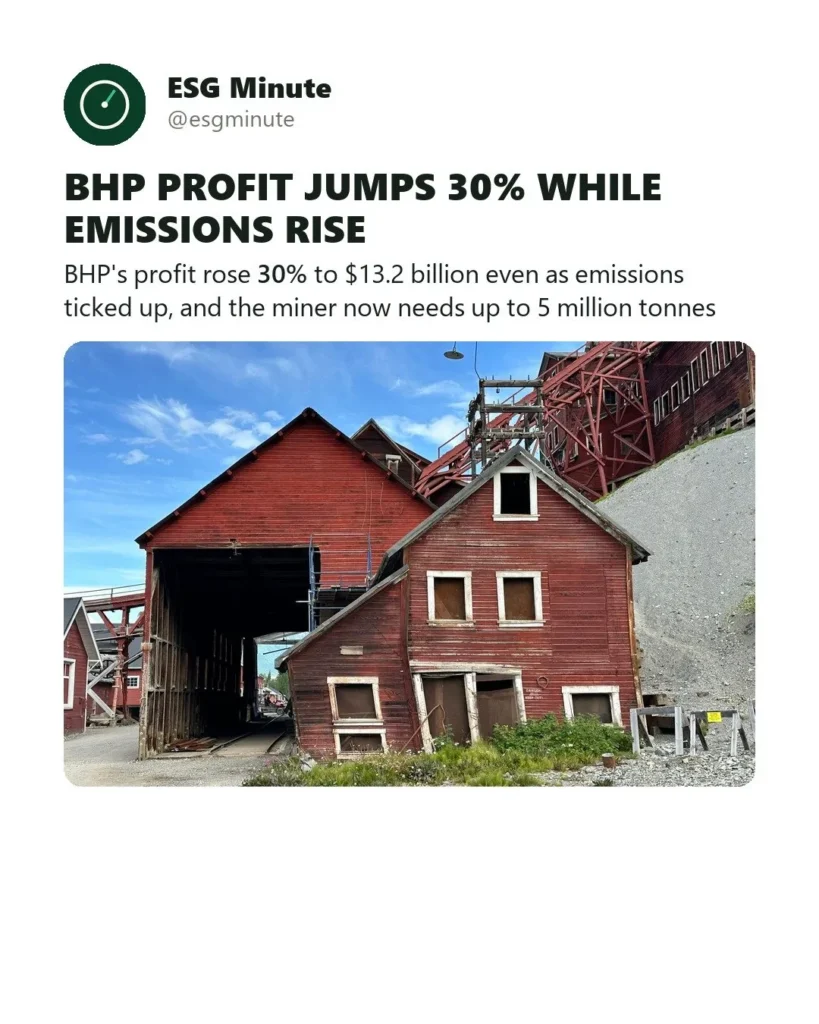
- BHP’s underlying attributable profit rose 30% year-on-year to $13.2 billion in FY2026, with copper making up over half of operating earnings for the first time
- Operational Scope 1 and 2 emissions rose 1% to 9.4 million tonnes of CO2e, even though that is still 33% below the company’s FY2020 baseline
- BHP now estimates it will need 3 to 5 million tonnes of carbon credits to offset the residual emissions it cannot eliminate on the way to its 2050 net-zero target
Why it matters: A 30% profit jump next to a 1% emissions increase is the exact pattern regulators and investors are trained to scrutinize: growth that outpaces decarbonization, with carbon credits now doing the job that operational change hasn’t caught up to yet.
BHP says battery-electric mining systems won’t see broad deployment until after 2030, and the company expects to need at least $4 billion in incremental spending in that decade just to keep the decarbonization plan on track.
Copper overtakes iron ore as BHP’s top earner
The shift in BHP’s earnings mix is not marginal. Copper, including gold and uranium byproducts, generated US$18.19 billion in operating earnings in FY2026, compared with US$14.53 billion from iron ore. That makes copper BHP’s largest earnings contributor for the first time. The company also produced around 2 million tonnes of copper for the second consecutive year.
Shareholders saw direct returns from the result. BHP declared US$1.72 per share in dividends, its highest payout in four years. Total dividends reached US$8.7 billion, equal to 66% of underlying attributable profit. Shares rose 2.65% to A$63.85 on August 18 after the results were published.
The practical consequence is that BHP’s financial case now depends more on a metal central to the energy transition (copper for wiring, motors, and batteries) than on steelmaking raw materials. That gives the company a narrative advantage when defending its climate strategy to investors, but it also raises the bar: a company that profits from the transition faces sharper questions when its own emissions go up.
Where emissions rose and why
The 1% year-on-year increase was not spread evenly. BHP reported higher emissions at BHP Mitsubishi Alliance (BMA) in Queensland because of increased material movement and mining in more methane-intensive areas. Emissions at New South Wales Energy Coal (NSWEC) also increased because of higher production volumes and a revised methane emissions model that changed how fugitive emissions are counted.
Stable performance at Western Australia Iron Ore and the Escondida copper mine in Chile helped balance some of those increases. The temporary suspension of Western Australia Nickel also contributed to holding the total down.
BHP also changed how it calculates Scope 2 emissions at its Australian operations, switching to a national residual mix factor (RMF) where available. Applying the new method retroactively changed the reported FY2025 comparison from a 36% reduction against the FY2020 baseline to 34%. That two-percentage-point shift is worth noting: methodology changes in emissions reporting can quietly move the goalposts, and investors comparing year-on-year figures need to read the footnotes.
How carbon credits fit into the plan (and the common mistake)
BHP says it intends to reduce emissions through structural measures wherever technology is mature, commercially available, and viable. Carbon credits enter the picture only for residual emissions that survive those measures. The company estimates that 3 to 5 million tonnes of CO2e could remain in calendar year 2050, and it would need carbon credits to cover that gap.
BHP stresses that this is an estimate, not a firm purchase commitment. The range could narrow if low- and zero-emissions technologies improve faster than expected.
The most common mistake companies make with carbon credit strategies is treating offsets as a substitute for operational cuts. When regulators or auditors see a company booking credits early in its decarbonization timeline (while cheap abatement options still exist), they flag the approach as avoidance rather than transition. BHP’s framing avoids that trap on paper by positioning credits as a last-mile tool. The test will come in the interim years: if operational emissions plateau or rise while the company accumulates credit contracts, the “last mile” framing loses credibility.
Battery-electric trials are underway, but broad rollout is years away
Diesel displacement is BHP’s largest remaining lever for cutting operational emissions. The company has made more progress on electricity: it reported 80% renewable electricity usage across its operated assets globally, and its BMA mines in Queensland moved to 100% renewable power from July 2026.
On the equipment side, BHP began trials of battery-electric haul trucks and locomotives during FY2026. At Jimblebar in Western Australia, it started testing two Caterpillar battery-electric haul trucks in March 2026. It also began trials involving two Wabtec FLXdrive battery-electric locomotives at Port Hedland.
However, BHP does not expect broad deployment across its operations until after FY2030. The company cites challenges around charging infrastructure, power systems, mine planning, maintenance, and workforce skills. In practice, replacing diesel in open-pit mining is harder than switching a power contract to renewables, because each mine site needs heavy electrical infrastructure that does not yet exist at scale.
Scope 3 emissions dwarf the operational footprint
BHP’s Scope 3 emissions reached 429.0 million tonnes of CO2e in FY2026, up 1% from 423.7 million tonnes in FY2025. That figure is roughly 45 times larger than its Scope 1 and 2 total. Downstream processing of iron ore and steelmaking coal accounted for 85% of reported Scope 3 emissions. Energy coal combustion contributed another 10%, direct suppliers 2%, and upstream and downstream shipping 1%.
BHP has a separate goal to reach net-zero Scope 3 emissions by 2050, but the company itself says reaching that goal is uncertain because it depends on customers adopting lower-emissions steelmaking technologies. This is the part of the equation BHP cannot engineer on its own.
Brazil’s carbon market and what it means for miners
Brazil enacted its regulated carbon market law (the Sistema Brasileiro de Comércio de Emissões, or SBCE) in December 2024. The system will cover facilities above a defined emissions threshold and require them to monitor, report, and eventually surrender allowances or credits for their greenhouse gas output. Implementing regulations are still being developed, and the timeline for when compliance obligations begin will determine how quickly the market affects mining operations in the country.
For a company like BHP, which operates in multiple jurisdictions and already factors carbon credit demand into its long-term plans, the emergence of Brazil’s regulated market adds another variable. If Brazilian allowance prices diverge from voluntary credit prices in other markets, miners operating across borders will face different cost signals for the same tonne of CO2e. The practical step for operators in Brazil right now is to ensure their emissions monitoring and reporting systems meet the SBCE’s requirements before compliance deadlines arrive.
What is still unresolved
Several questions remain open. First, BHP has not disclosed a target price or budget for the 3 to 5 million carbon credits it may need. Credit prices vary widely depending on project type and registry, and locking in supply at today’s prices versus buying closer to 2050 involves different financial and reputational risks. Second, the company’s Scope 3 goal depends on steelmaking customers adopting technologies (such as hydrogen-based direct reduction) that are not yet deployed at commercial scale. Third, the gap between the current battery-electric truck trials and broad fleet replacement leaves at least four to five years where diesel remains the primary fuel for heavy mining equipment, with no guarantee that charging infrastructure will be ready when the trucks are.
The deciding factor is speed. If operational emissions stay flat or rise through the late 2020s while profits grow, the carbon credit estimate will look less like a residual buffer and more like a structural dependency.
via Carbon Credits
There is no newsletter yet. Leave your email and you will hear first on the day there is one.