The minute
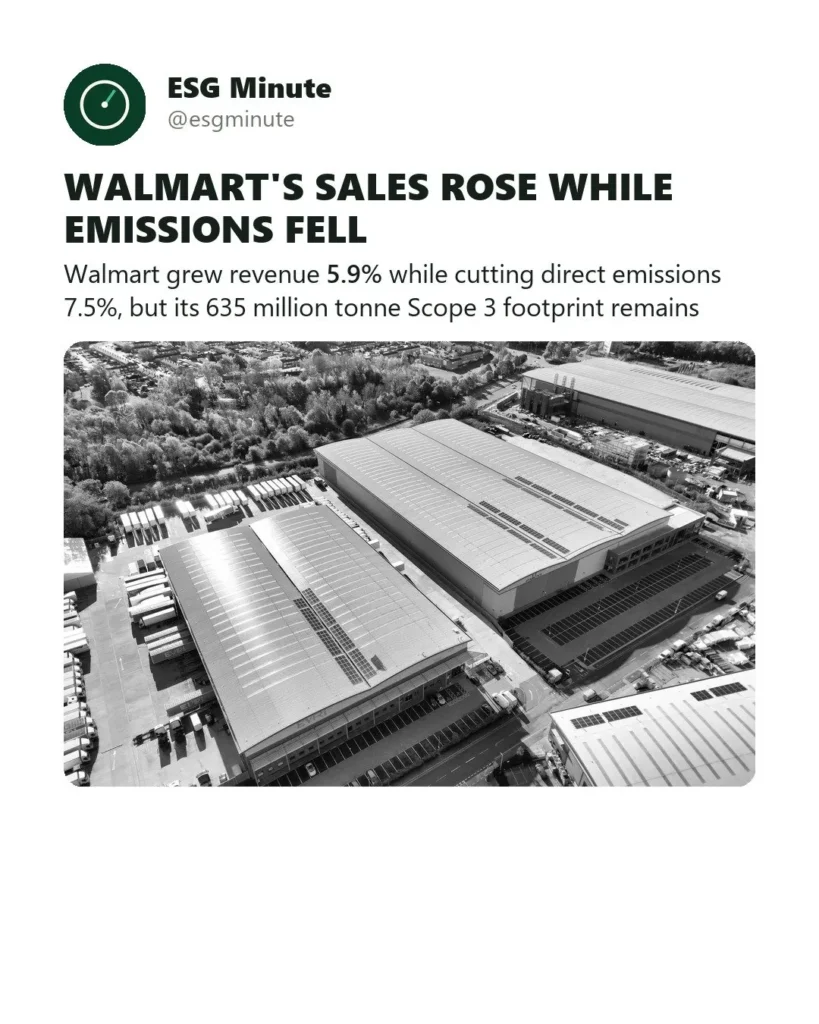
Walmart reported Q2 FY2027 revenue of $187.9 billion, up 5.9% year-over-year, with global e-commerce surging 23%. The retailer cut Scope 1 and 2 emissions 7.5% year-over-year, a cumulative 24.6% reduction since FY2016, while renewable energy now supplies 53.3% of global electricity, above its original 50% target. Walmart aims for zero Scope 1 and 2 emissions by 2040 without relying on offsets, but its Scope 3 supply chain emissions were estimated at 635 million tonnes of CO2e in FY2026, dwarfing its direct footprint.
Why it matters: Growing revenue while cutting direct emissions is exactly the decoupling companies are supposed to achieve, and Walmart is doing it without leaning on carbon offsets for its own operations, which is the harder and more credible path. The gap between Walmart’s shrinking direct footprint and its 635 million tonne Scope 3 number is the real story: for a retailer, almost all the climate impact sits with suppliers, not stores, and that is a much slower problem to fix.
Strong top line, but U.S. sales lost momentum
The $187.9 billion quarter was not uniformly strong. Walmart U.S. comparable sales grew just 2.6%, the company’s slowest quarterly comparable-sales growth in six years and below the 3.8% that analysts had expected. Despite the miss, Walmart raised its full-year fiscal 2027 outlook to 4% to 5% net sales growth.
Investors were not reassured. Walmart shares fell about 9.1% on August 20, 2026, even though the company beat overall earnings and revenue estimates. The selloff shows how sensitive the market is to any sign that the consumer spending engine behind Walmart’s scale is cooling. That scale is precisely what makes Walmart’s climate commitments consequential: changes in energy, transport, refrigeration and packaging ripple across operations in 19 countries.
How Walmart is cutting Scope 1 and 2 in practice
Scope 1 covers emissions from sources Walmart owns or controls (fuel burned in trucks, natural gas in buildings, refrigerant leaks). Scope 2 covers emissions linked to purchased electricity. The 7.5% year-over-year reduction came from a combination of levers, not a single fix.
On the electricity side, Walmart crossed the 53.3% renewable share by contracting solar, wind and other clean sources across its global facility base. Its longer-term target is 100% renewable electricity by 2035. On the operations side, the company is shifting to lower-impact refrigerants in stores, electrifying warehouse equipment and deploying cleaner vehicles in its private fleet. Emissions intensity (emissions per unit of revenue) fell 11.6% year-over-year and 53.7% from the FY2016 baseline, which means Walmart is not just cutting total emissions but cutting them faster than it grows.
Walmart has also expanded customer-facing infrastructure tied to the energy transition. Its U.S. stores and clubs had more than 1,300 electric vehicle charging stations as of FY2025.
Project Gigaton and the Scope 3 accounting gap
Walmart’s main tool for its supply chain footprint is Project Gigaton, a programme that asks suppliers to set targets and report progress on energy, packaging, waste, product design and nature. In FY2026, more than 4,300 suppliers reported results, with 187 million metric tons of CO2e in expected emissions avoided, reduced or sequestered. Since the programme launched in 2017, cumulative reported results have topped 1.37 billion metric tons, exceeding Walmart’s original one billion tonne goal for 2030.
Those numbers need careful reading. Project Gigaton tallies are supplier-reported expected reductions and should not be treated as direct cuts to Walmart’s own Scope 3 inventory. The distinction matters because Walmart’s estimated Scope 3 emissions still reached 635 million tonnes of CO2e in FY2026. Although Scope 3 emissions intensity improved 8.29% from FY2022, total Scope 3 emissions increased as Walmart grew and its product mix changed. In other words, suppliers are reporting progress, but the absolute number keeps rising alongside the business.
The most common mistake when reading these numbers
Companies and analysts frequently conflate supplier-reported avoided emissions with actual reductions in a retailer’s value chain inventory. Avoided emissions measure what would have happened under a baseline scenario. Inventory emissions measure what actually entered the atmosphere. A supplier can report significant avoided emissions while its absolute output still grows, because the baseline assumes even higher output. Treating the two as interchangeable overstates real progress and obscures how much work remains.
What this means for operations in Brazil
Walmart no longer operates stores in Brazil directly, but the Scope 3 logic applies to every large retailer in the country. Brazil’s Programa Brasileiro GHG Protocol, managed by FGV (Fundação Getulio Vargas), provides the main corporate greenhouse gas reporting framework. Companies that participate publish annual inventories following the same Scope 1, 2 and 3 structure Walmart uses globally. In addition, CVM (Brazil’s securities regulator) adopted Resolution 193 in 2023, which aligns listed company sustainability disclosures with the ISSB standards. Once fully phased in, publicly traded retailers in Brazil will face mandatory reporting of climate risks and emissions data, making the kind of Scope 3 transparency Walmart publishes voluntarily a regulatory requirement rather than a choice. Operators sourcing from Brazilian agricultural supply chains face a particular challenge, because land-use change and deforestation-linked emissions can dominate Scope 3 inventories in food and commodities retail.
Beyond carbon: nature and land commitments
Walmart’s sustainability reporting also covers natural systems. In FY2026, suppliers and grantees reported sustainably managing, protecting or restoring 76.2 million acres of land and 3.68 million square miles of ocean. The Walmart Foundation has invested more than $120 million since FY2021 in projects linked to natural-resource protection, including $30.5 million in FY2026. These programmes exist because forests, grasslands and oceans underpin the supply chains behind many of Walmart’s products, from seafood to cotton to palm oil.
What remains unresolved
Three questions will determine whether Walmart’s climate strategy holds up over the next decade. First, whether Scope 3 absolute emissions can actually decline while the business keeps growing, something Project Gigaton has not yet delivered. Second, whether the 2035 target for 100% renewable electricity is achievable across 19 countries with very different grid and regulatory conditions. Third, whether investors and regulators will continue to accept supplier-reported figures as evidence of supply chain progress, or demand third-party verified inventory data instead. The answers will shape not just Walmart’s trajectory but the expectations placed on every large retailer worldwide.
via Carbon Credits
There is no newsletter yet. Leave your email and you will hear first on the day there is one.