The minute
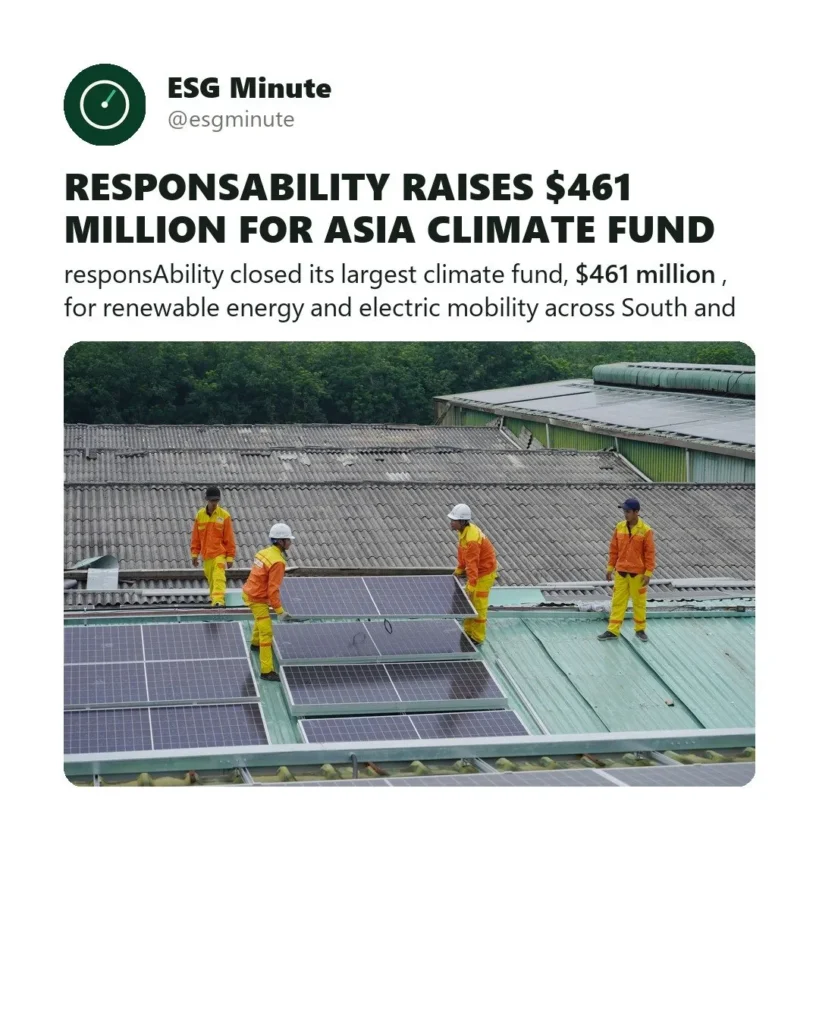
- responsAbility, M&G’s impact investing unit, closed its Asia Climate Fund at $461 million, its largest closed-end climate fund to date and one of the most successful private credit fundraises focused on climate investment in South and Southeast Asia
- The fund has already committed about $204 million across 17 portfolio companies, focused on renewable energy, electric mobility, energy efficiency, circular economy solutions and climate infrastructure in South and Southeast Asia
- The structure uses blended finance, combining public-sector risk capital with private institutional commitments, mobilizing over 5 times the concessional amount in commercial funding
Why it matters: Using blended finance to mobilize 5 times the concessional capital in commercial funding is the kind of structure other emerging-market climate funds should watch closely, since it shows a way to make public capital go further without becoming a permanent subsidy. The fund is specifically betting that demand for renewable power, distributed energy, electric mobility and efficiency will grow substantially in Asia, a thesis that echoes the same kind of emerging-market expansion funds like CIP’s are also chasing.
How blended finance works in practice
Blended finance brings together public or philanthropic capital and private funding through a common investment structure. The mechanism exists because certain climate investments, particularly in emerging markets, carry perceived risk profiles that discourage commercial investors from entering on their own. A public or development finance institution provides concessional capital (capital offered at below-market terms or in a first-loss position), which absorbs part of the downside risk. That risk cushion makes the remaining portion of the fund attractive enough for private institutional investors, such as pension funds and insurers, who need risk-adjusted returns that meet their fiduciary obligations.
In the case of the Asia Climate Fund, the concessional layer unlocked more than five times its size in commercial commitments. In practical terms, this means that for every dollar of public risk capital placed into the structure, private investors contributed more than five dollars. The fund then deploys the combined pool as private credit to portfolio companies, lending rather than taking equity stakes. Private credit is the core strategy here: responsAbility is not buying ownership in these companies but extending debt financing, which gives the fund a more predictable return profile tied to interest payments and repayment schedules.
Why Asia remains undercapitalized for climate infrastructure
According to responsAbility, Asia’s economies are expanding, urbanizing and electrifying at a pace that creates enormous demand for electricity, fleet electrification, industrial efficiency and lower-carbon infrastructure. Yet the region remains undercapitalized relative to the scale of those needs. The gap is not about a lack of viable projects. It is about a financing mismatch: commercial lenders in South and Southeast Asia often lack the mandate, the risk appetite or the ticket size flexibility to serve mid-market companies working in renewable energy or electric mobility. Blended finance structures like this one are designed to sit in that gap, using concessional capital to bring in institutional money that otherwise would not flow to these borrowers.
Stephanie Bilo, Chief Client & Investment Solutions Officer at responsAbility, described the final close as “a strong vote of confidence from our investors” and pointed to “the increasing relevance of Asia’s climate transition as an institutional investment opportunity.” She noted that the region combines scale, growth and significant capital needs across renewable energy, mobility and efficiency, while offering the potential for returns through disciplined private credit strategies.
The Brazilian parallel
Brazil faces a similar financing gap for climate infrastructure, though the institutional landscape differs. The country’s national development bank, BNDES, has historically played the concessional role in climate-related lending, offering subsidized credit lines for renewable energy, energy efficiency and sustainable agriculture. The challenge in Brazil is that blended finance as a formal structure (with layered risk tranches combining public and private capital in a single vehicle) remains less common than in Asia or sub-Saharan Africa. Most climate lending still runs through direct BNDES credit lines or through earmarked green bond issuances by commercial banks, rather than through pooled fund structures that layer concessional and commercial capital the way the Asia Climate Fund does.
For Brazilian operators and investors watching this model, the practical takeaway is structural. A blended finance fund pools risk in a way that a single BNDES credit line does not: the concessional tranche absorbs losses first, giving private investors a defined level of protection. Replicating this in Brazil would require development finance institutions or multilateral banks to commit capital specifically as a first-loss or junior tranche within a fund, rather than lending directly to end borrowers. That shift in architecture is what allows the 5x mobilization ratio responsAbility achieved.
The most common mistake in blended finance
The most frequent error in blended finance design is setting the concessional share too high. When public capital accounts for half or more of a fund, private investors receive so much downside protection that the structure effectively becomes a subsidy rather than a mobilization tool. The fund may deploy capital successfully, but it fails to demonstrate that the underlying investments can attract commercial money on reasonable terms. Future fundraises then struggle because investors and policymakers question whether the asset class genuinely works without heavy concessionality. The Asia Climate Fund’s 5x ratio suggests responsAbility calibrated the concessional layer to be large enough to attract private capital but small enough to avoid the subsidy trap.
What is still unresolved
The fund has committed $204 million of its $461 million total, leaving more than half the capital still to be deployed. How quickly and at what quality that remaining capital gets placed will determine whether the structure delivers on its thesis. Private credit funds in emerging markets also face currency risk, since many portfolio companies earn revenue in local currencies while the fund likely reports in US dollars. responsAbility has not disclosed its currency hedging strategy for this fund. Finally, the broader question for blended finance remains open: whether structures like this can scale beyond individual fund vehicles into a repeatable model that channels institutional capital into climate infrastructure across multiple emerging markets simultaneously, without requiring bespoke negotiation for every new fund.
via ESG Today
There is no newsletter yet. Leave your email and you will hear first on the day there is one.