The minute
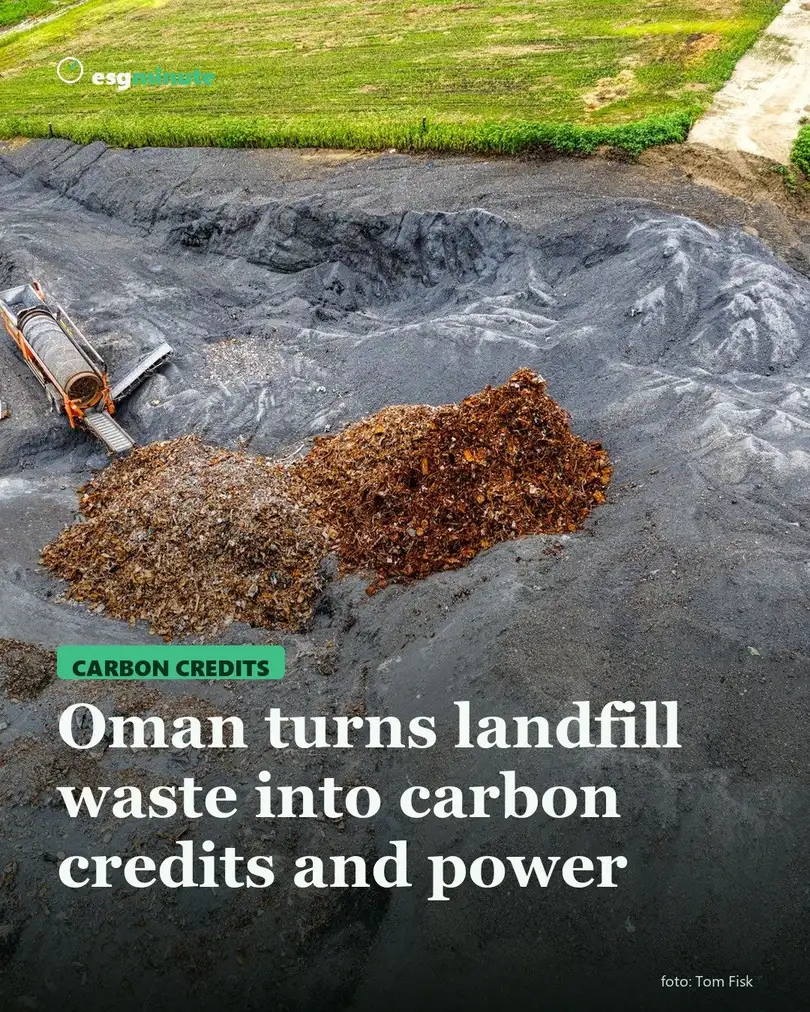
- Oman’s state waste operator be’ah is capturing methane from the Al Multaqa and Barka landfills to generate on-site electricity, instead of simply flaring the gas released by organic waste
- By May 2025, the two projects had already generated 67,700 verified carbon units (about 39,000 from Al Multaqa and 28,700 from Barka), verified under the Verra standard as Project #4544 and Project #4550, both registered in 2024
- Landfill emissions account for 91.9% of be’ah’s own Scope 1 emissions, making this project central to the company’s sustainability target, not just a side product
Why it matters: Capturing landfill methane is one of the few cases where cutting your own emissions and generating carbon credit revenue happen at the same time, without depending on a third-party offset, since the avoided methane would have been emitted anyway. Oman handled 2.88 million tonnes of municipal solid waste in 2025, with landfill capacity expanding, which suggests this model has room to grow domestically before there’s even a case for replicating it elsewhere.
How large the emissions footprint actually is
be’ah’s 2024 greenhouse gas inventory reported 1.285 million tonnes of CO2e in combined Scope 1 and Scope 2 emissions. Scope 1 alone accounted for 1.279 million tonnes, while Scope 2 (purchased electricity) stood at just 6,672 tonnes. Within Scope 1, solid waste disposal sites produced 91.9%, mobile combustion from the municipal waste-collection fleet contributed 4.9%, and flaring accounted for 1.5%. The ratio makes it clear why landfill gas is the priority: no other intervention in be’ah’s operations comes close to the same reduction potential.
From flaring to power generation
The next phase moves beyond carbon credits. be’ah began building landfill gas-to-electricity systems in January 2025, with completion scheduled for July 2026. By the end of 2025, overall progress had reached about 55%.
At Al Multaqa, the existing flaring system has a capacity of 2,000 normal cubic meters per hour (Nm³/hr). Estimated recoverable landfill gas is about 430 Nm³/hr, with potential electricity generation of around 460 kilowatts. At Barka, the flaring system has a capacity of 2,500 Nm³/hr, with estimated recoverable gas of about 530 Nm³/hr and potential generation of around 600 kilowatts. Together, the two sites could produce about 1.06 megawatts at estimated recovery levels, enough to power the landfill sites themselves and, at full capacity, potentially export surplus electricity.
Oman’s first Biennial Transparency Report submitted to the UN Framework Convention on Climate Change estimated average annual reductions of 113,864 tonnes of CO2e for direct methane use at Al Multaqa and 303,542 tonnes of CO2e for electricity generation at Barka and Al Multaqa combined. These are estimated mitigation potentials, not verified carbon credits. Actual credits depend on project monitoring, verification, and issuance under the relevant standard.
How landfill gas-to-credit works in practice
For operators considering a similar path, the process follows a sequence that be’ah has formalized into a five-stage Carbon Management Framework: carbon accounting (measuring what the site emits), identifying reduction projects (choosing where gas capture is viable), registering and verifying those projects under a carbon standard such as Verra VCS, issuing and selling or retiring the resulting credits, and integrating carbon activity into financial management.
The practical steps at the landfill itself start with installing a gas collection system (vertical wells or horizontal trenches drilled into the waste mass, connected by piping to a central collection point). Collected gas goes either to a flare (the baseline scenario) or to a generator that converts methane into electricity. Monitoring equipment tracks gas flow, composition, and the volume of methane destroyed or converted. That monitoring data feeds into the verification cycle required by the carbon standard.
OQ Trading (OQT) supported be’ah in project development, certification, verification, and marketing of the credits. Al Multaqa received credits covering 2021 and 2022 vintages, while Barka received credits for 2022. Each VCU represents one metric tonne of CO2e reduced.
The most common mistake
Operators frequently treat flaring as a permanent solution and never move to energy recovery. Flaring destroys methane (converting it to CO2, which has a lower warming potential), but it wastes the energy content of the gas entirely. The difference matters for carbon credit eligibility too: some methodologies grant fewer credits for flaring-only projects because they capture less of the total climate benefit. Starting with flaring is reasonable as a safety measure, but staying there indefinitely leaves revenue and emissions reductions on the table.
What this means for Brazil
Brazil’s Política Nacional de Resíduos Sólidos (PNRS, Lei 12.305/2010) required the closure of open dumps and the transition to engineered landfills, but implementation has been slow in many municipalities. Landfill gas capture is not universally mandated, which means most sites still vent or flare methane without recovering energy or generating credits. Brazil was an early participant in landfill gas carbon projects under the Clean Development Mechanism, but the volume of registered projects has not kept pace with the country’s waste generation. For Brazilian operators, the practical change is that the voluntary carbon market (and the regulated market under development) now offers a revenue pathway that can help finance the gas collection infrastructure that the PNRS framework envisions but does not fund directly.
What remains unresolved
Oman’s waste volumes are growing. Municipal solid waste rose from 2.57 million tonnes in 2024 to 2.88 million tonnes in 2025. Industrial waste intake jumped from 12,649 tonnes to 43,216 tonnes in the same period. be’ah commissioned about 2.2 million tonnes of new engineered landfill capacity during 2025 and is developing another 3.4 million tonnes at Thumrait. More waste means more landfill gas over time, which expands the pool of potential credits but also increases the baseline emissions that need to be managed.
The open question is whether carbon credit revenue alone can justify the capital cost of gas-to-electricity systems at smaller or newer sites, where gas generation rates are lower. be’ah has not published cost-per-VCU figures for either project. Until that economics question is answered transparently, replication (in Oman or elsewhere) depends on each operator running its own feasibility analysis rather than following a proven financial template.
via Carbon Credits
There is no newsletter yet. Leave your email and you will hear first on the day there is one.