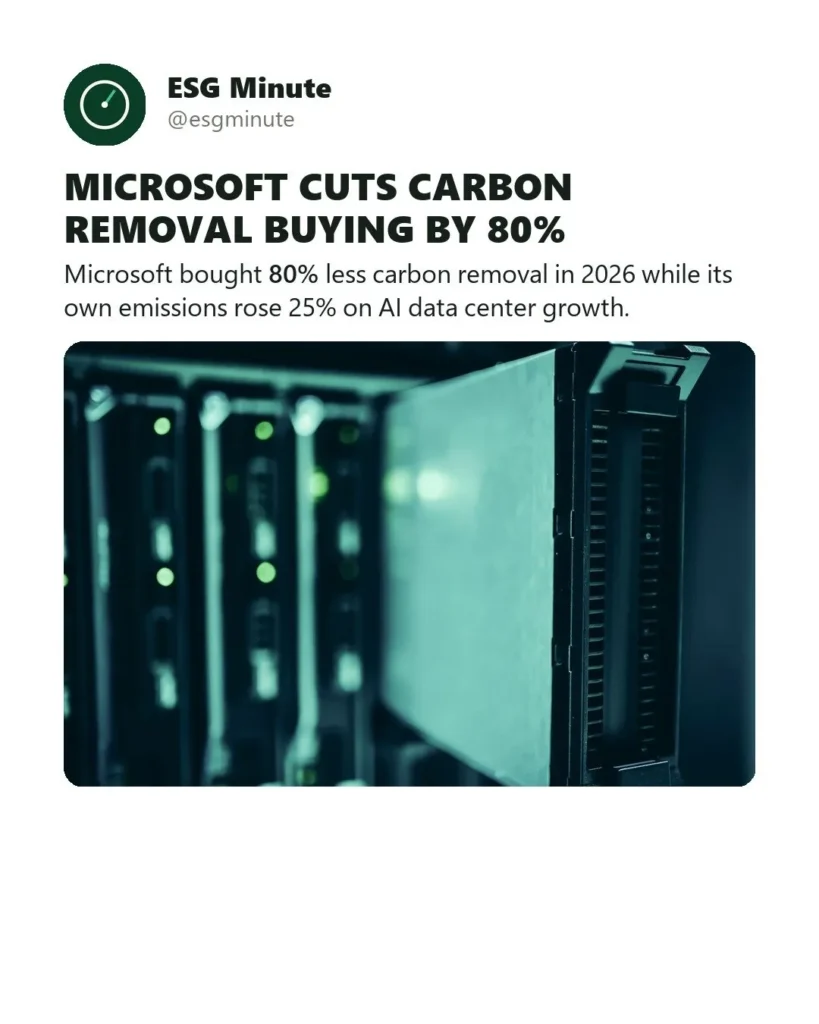
The minute
- Microsoft bought only 8.55 million tonnes of carbon removal through mid-July 2026, an 80% drop from the same period in 2025
- The company’s total emissions rose 25% in fiscal 2025 to about 20 million tonnes of CO2e, driven mainly by data center expansion for AI
- Microsoft still signed a May 2026 deal for 650,000 tonnes from BioCirc, calling the pullback a “more selective approach”, not a change in ambition
Why it matters: The gap between rising emissions and falling removal purchases is exactly the math that determines whether Microsoft’s 2030 carbon negative target is still reachable, and right now the two lines are moving in opposite directions.
In fiscal 2025 Microsoft had signed a record 45 million tonnes of removal deals, nine times its fiscal 2023 volume, so this year’s slowdown is a sharp reversal, not a gradual trend.
What the numbers actually show
Microsoft’s fiscal 2025 sustainability report breaks emissions into three scopes. Scope 2 emissions (from purchased electricity) jumped from nearly 2% of the company’s total footprint in fiscal 2024 to 13% in fiscal 2025. Microsoft attributed the shift to the growing role of electricity systems across its operations and supply chain, and to its decision to stop using some non-additional, unbundled renewable energy certificates that had previously masked grid-related emissions.
Scope 3 (supply chain, construction materials, servers, equipment) remains the largest share of Microsoft’s overall footprint. That matters because every new data center built for AI adds Scope 3 emissions long before it draws its first watt.
In fiscal 2024, Microsoft had already reported total emissions 23.4% above its 2020 baseline. Energy consumption had increased 168% over the same period, while revenue grew 71%. The latest 25% year-over-year rise means the gap between emissions growth and revenue growth is widening, not closing.
Where the removal money went
The 45 million tonnes contracted in fiscal 2025 were spread across 21 companies and covered a wide range of removal technologies: nature-based projects, biochar, carbon mineralization, and engineered carbon removal. Microsoft has described the program as a deliberate effort to build a market for technologies that can remove carbon at scale, not just to offset its own footprint.
That distinction matters. A buyer this large does not simply purchase credits; it sets the price signal that project developers use to raise capital. When Microsoft doubles its contracted volume in a single year and then cuts purchasing by 80% the next, the signal to developers and investors is abrupt.
The broader carbon market context
Microsoft’s pullback lands in a market that is growing but still fragile. The World Bank’s State and Trends of Carbon Pricing 2026 report found that global carbon credit issuance rose 8% between 2024 and 2025. However, overall credit prices declined slightly. Credits with strong ratings or high-integrity labels continued to command premiums, while lower-quality credits lost ground.
Companies signed about $12 billion in offtake agreements for future carbon credits in 2025, three times the level recorded in 2024. That figure sounds large, but the market remains heavily dependent on a small number of corporate buyers. Microsoft has been the single biggest driver of demand for carbon removal. A sustained reduction in its purchases could slow project pipelines and discourage new entrants in the removal technology space.
What Microsoft is doing instead
Reduced removal purchases do not mean Microsoft has dropped climate spending altogether. The company reported that it matched 100% of its annual global electricity consumption with renewable energy in fiscal 2025. It has contracted 34 GW of carbon-free electricity across 24 countries. And it says it is expanding its focus on adding new carbon-free generation to the grids where it operates, rather than relying on certificates from distant sources.
The long-term target remains: carbon negative by 2030, and by 2050 remove from the atmosphere an amount of carbon equal to all direct and electricity-related emissions since the company’s founding in 1975. A Microsoft spokesperson told Bloomberg News that “any adjustments we make are part of our disciplined approach, not a change in ambition.”
Brazil connection
Brazil established its regulated carbon market (the SBCE, Sistema Brasileiro de Comércio de Emissões) through legislation signed in late 2024. The system will require companies above a certain emissions threshold to monitor, report, and eventually offset or reduce their carbon output. Implementing regulations are still being finalized, so the exact scope and timeline for compliance remain open.
For Brazilian operators watching Microsoft’s moves, the practical takeaway is about credit quality. As large buyers become more selective, removal credits from Brazil (particularly nature-based solutions in the Amazon biome) will face tighter scrutiny on additionality and permanence. Projects that cannot demonstrate high-integrity measurement and verification risk being excluded from the portfolios of buyers like Microsoft, even as overall demand for removal grows.
The common mistake
The most frequent error companies make when building a carbon removal strategy is treating credit purchases as a substitute for operational emission reductions. Buying removal tonnes is simpler than redesigning a supply chain or switching energy sources, so procurement teams default to it. When budgets tighten (as Microsoft’s removal budget apparently has), the company is left with higher emissions and fewer offsets at the same time. Microsoft’s own data illustrates the trap: emissions rose 25% in a single year while the tool meant to compensate for them shrank by 80%.
What is still unresolved
Two questions will determine whether Microsoft’s 2030 target survives. First, whether the company’s clean energy contracts (34 GW across 24 countries) translate into actual grid decarbonization fast enough to bend the Scope 2 curve back down. Contracting power and delivering electrons are not the same thing, and construction timelines for wind, solar, and nuclear projects routinely slip.
Second, whether AI infrastructure growth stabilizes or keeps compounding. Microsoft has not disclosed a projected emissions trajectory for fiscal 2026 or beyond. Without that number, outside observers cannot judge whether the current removal slowdown is a strategic pause or the beginning of a structural shortfall.
Investors, for now, appear unconcerned. Microsoft shares rose about 0.5% on the day the reduced purchasing figures became public, suggesting the market is pricing AI revenue growth above climate risk. That calculation holds until it doesn’t.
via Carbon Credits
There is no newsletter yet. Leave your email and you will hear first on the day there is one.