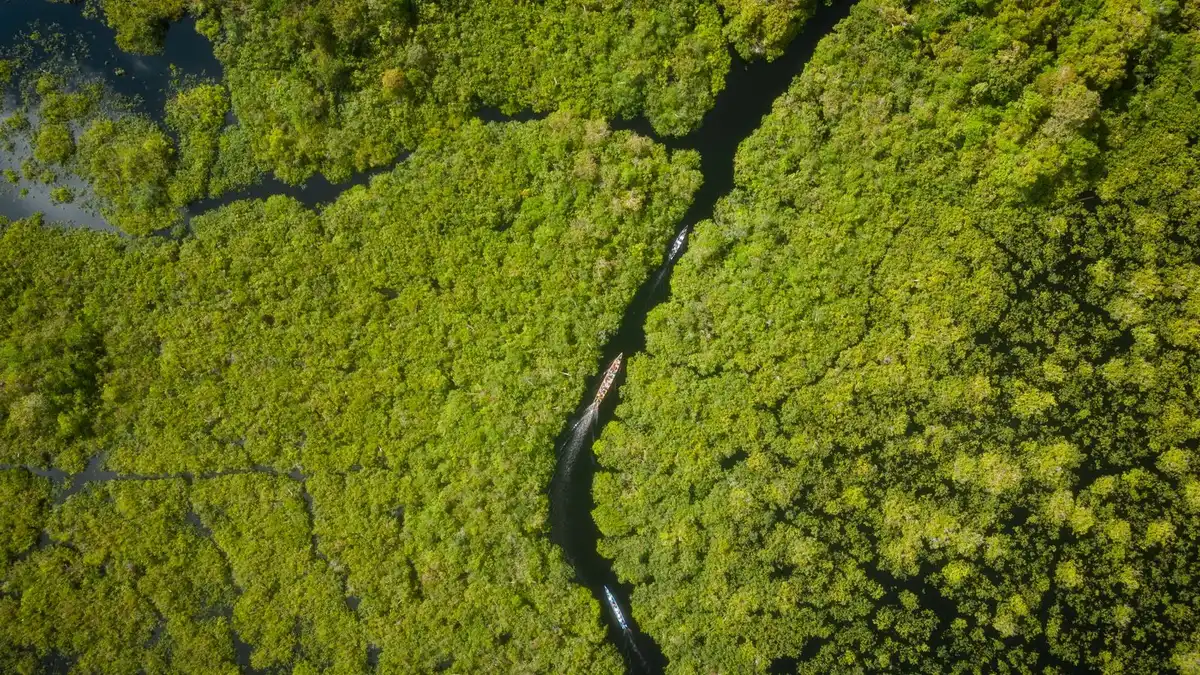
Indonesia carbon credits sit at the intersection of one of the world’s largest tropical forest reserves and one of its fastest-evolving regulatory frameworks for carbon pricing. The country spans more than 17,000 islands, holds the third-largest tropical rainforest area on the planet, and manages vast peatland and mangrove ecosystems with enormous carbon storage potential. For project developers, investors, and corporate buyers, understanding how this market operates is not optional. It is a prerequisite for participation.
What Are Indonesia Carbon Credits?
A carbon credit generated in Indonesia represents one metric tonne of CO₂ equivalent (tCO₂e) that has been reduced, avoided, or removed from the atmosphere through a verified project within Indonesian territory. These credits can originate from activities such as REDD+ (Reducing Emissions from Deforestation and Forest Degradation), peatland restoration, mangrove conservation, renewable energy deployment, or methane capture from waste management.
Indonesia’s carbon credits exist in two broad categories. Compliance credits are linked to the country’s cap-and-trade mechanism for regulated sectors, starting with the power sector. Voluntary credits are generated by independent projects certified under recognized standards and traded on the voluntary carbon market, both domestically and internationally.
The Regulatory Framework
Indonesia’s carbon market regulation has undergone a significant overhaul in recent years. The foundational legal instrument was Presidential Regulation No. 98 of 2021 (Perpres 98/2021), which established the concept of Carbon Economic Value (Nilai Ekonomi Karbon, or NEK) and created the initial architecture for carbon pricing, including carbon trading, a carbon tax, result-based payments, and carbon offsets.
In October 2025, Perpres 98/2021 was revoked and replaced by Presidential Regulation No. 110 of 2025 (Perpres 110/2025), titled “Implementation of Carbon Economic Value Instruments and National Greenhouse Gas Emission Control.” This regulation introduced several structural changes:
- Decoupling from NDC timeline. Voluntary carbon projects can generate and sell credits internationally without waiting for national NDC target fulfillment, reducing regulatory risk for investors.
- International trading categories. International carbon credit transactions are divided into CA Units (requiring corresponding adjustment under Article 6 of the Paris Agreement) and Non-CA Units (not requiring corresponding adjustment). This distinction determines whether the emission reduction counts toward Indonesia’s NDC or toward the buyer’s country targets.
- Nesting approach. Individual project-level carbon accounting must align with national greenhouse gas inventories to prevent double counting. Projects are nested within jurisdictional and national accounting frameworks.
- Recognition of international standards. The government signed Mutual Recognition Agreements (MRAs) with Verra, Gold Standard, Plan Vivo, and the Global Carbon Council. Projects certified under these standards are permitted, provided they also register on Indonesia’s national system.
A Steering Committee, chaired by the Coordinating Minister for Food Affairs and including ministers responsible for environment, finance, energy, investment, and industry, oversees cross-sectoral implementation of carbon economic value instruments.
The National Registry and IDXCarbon Exchange
Indonesia maintains a National Registry System for Climate Change Control (Sistem Registrasi Nasional Pengendalian Perubahan Iklim, or SRN PPI), which tracks mitigation actions, carbon credit issuance, and transfers. The government launched an updated registry system known as SRUK (Sistem Registrasi Unit Karbon) in 2026 to serve as the central repository for carbon unit tracking and trading.
All carbon projects operating in Indonesia must register their activities and report mitigation performance to this national registry on an annual basis, regardless of whether they also hold certification from an international standard.
For exchange-based trading, the Indonesia Stock Exchange (IDX) operates IDXCarbon, a regulated carbon exchange launched on September 26, 2023. IDXCarbon is supervised by the Financial Services Authority (OJK) under OJK Regulation No. 14 of 2023 (POJK 14/2023). The exchange offers four trading mechanisms: Auction, Regular Trading, Negotiated Trading, and Marketplace. Trading hours run from 09:00 to 15:00 local time. International trading came later: according to the International Carbon Action Partnership (ICAP), Indonesia has authorised selected credits for international transfer since January 2025.
Who Can Participate
The market is open to several categories of participants:
- Project developers who originate credits from eligible activities such as forest conservation, peatland rewetting, renewable energy, or waste-to-energy projects on Indonesian territory.
- Domestic corporations in regulated sectors (starting with coal-fired power plants; according to ICAP, the first phase in 2023 and 2024 covered grid-connected coal plants of 25 MW or more) that must meet compliance obligations under the cap-and-trade system.
- Voluntary buyers, both domestic and international companies purchasing credits to meet corporate climate commitments or ESG targets.
- Traders and intermediaries registered as Service Users on IDXCarbon who facilitate transactions between originators and end buyers.
Step by Step: How to Originate or Buy Credits
For Project Developers (Originating Credits)
- Identify the project type and methodology. Determine which activity applies (REDD+, peatland restoration, blue carbon, renewable energy, waste management). Select an accepted methodology from a recognized standard such as Verra’s Verified Carbon Standard (VCS), Gold Standard, Plan Vivo, or the government’s own SPE-GRK mechanism.
- Register on the national registry. Submit the project to Indonesia’s SRN PPI/SRUK system. This is mandatory for all projects regardless of the certifying standard used.
- Obtain necessary permits. Secure land-use permits, environmental impact assessments (AMDAL), and sector-specific approvals from the Ministry of Environment and Forestry (KLHK) or relevant provincial authorities.
- Conduct Measurement, Reporting, and Verification (MRV). Implement monitoring protocols per the selected methodology. Engage an independent third-party auditor (Validation and Verification Body, or VVB) accredited by the relevant standard.
- Obtain credit issuance. Upon successful verification, the certifying standard issues the carbon credits. These must also be recorded in the national registry. For international sale of CA Units, obtain a Letter of Authorization from the Indonesian government for corresponding adjustment.
For Buyers (Purchasing Credits)
- Register on IDXCarbon. Complete the Carbon Exchange Service User Registration Form. Submit required documents: company deed, statutes, tax identification number, business license, audited financial reports, and bank account details. International entities must also provide a Legal Entity Identifier (LEI).
- Obtain a carbon trading training certificate from a recognized institution, as required by POJK 14/2023.
- Wait for account activation. Document verification and account setup typically takes two to four weeks.
- Select credits and execute trades. Browse available carbon units on the IDXCarbon dashboard. Choose from Auction, Regular Trading, Negotiated Trading, or Marketplace mechanisms depending on volume and pricing preferences.
- Record the retirement or transfer. Once purchased, credits can be retired against corporate emissions targets or held for future use. All transactions are recorded in the national registry.
Buyers can also purchase credits bilaterally (off-exchange) through direct agreements with project developers or brokers. These over-the-counter transactions must still be registered in the national system.
Common Mistakes
- Skipping national registry enrollment. Even projects certified by Verra or Gold Standard must register on Indonesia’s SRN PPI/SRUK. Failure to do so can result in credits being unrecognized domestically and may create legal complications for international transfers.
- Ignoring the CA vs. Non-CA distinction. Buyers intending to use Indonesian credits for compliance in their own jurisdictions (under Article 6 of the Paris Agreement) need CA Units with corresponding adjustment authorization. Non-CA Units do not carry this authorization and cannot be used for that purpose.
- Underestimating land tenure complexity. Indonesia’s land governance involves overlapping claims from customary (adat) communities, national forestry maps, and provincial land registries. Unclear tenure is a frequent source of project delays and disputes.
- Assuming all forestry credits are equal. Credit rating agencies such as BeZero and Sylvera apply different ratings to Indonesian nature-based projects based on additionality, permanence, and leakage risk. Buyers should review independent ratings before purchasing.
- Neglecting the nesting requirement. Projects that do not align their accounting with national and jurisdictional baselines risk double counting flags, which can reduce credit value or block international transfers.
What to Do Now
- Read Presidential Regulation 110/2025 in full. The official text, available through Indonesia’s national legal database (JDIH), is the binding reference. Do not rely solely on summaries.
- Review POJK 14/2023 if you plan to trade on IDXCarbon. This regulation governs exchange registration, trading rules, and settlement procedures.
- Contact IDXCarbon directly at support.idxcarbon@idx.co.id to begin the Service User registration process and confirm current document requirements for your entity type.
- Engage local legal counsel with experience in Indonesian environmental law and carbon regulation. Land tenure, forestry permits, and cross-ministerial approvals require jurisdiction-specific expertise.
- Monitor SRUK developments. The national carbon unit registry is still maturing. Implementation details, including integration protocols with international standards, are subject to updates through ministerial regulations and technical guidelines.
Indonesia’s carbon market is large, complex, and evolving. But the regulatory direction is clear: the country intends to be a major supplier of carbon credits globally, with structured access for both domestic and international participants. Early preparation and regulatory literacy separate successful market entrants from those caught off guard by compliance gaps.
Primary sources: Presidential Regulation 110 of 2025 on Carbon Economic Value, official text in Indonesian (Government of Indonesia, 2025); IDXCarbon Monthly Report, Vol. 1, launch and trading mechanisms (Indonesia Stock Exchange, 2024); Paris Agreement, official text, Article 6 (UNFCCC, 2015); Decisions 2/CMA.3 and 3/CMA.3, rules for Article 6.2 and 6.4 (UNFCCC, 2022).
There is no newsletter yet. Leave your email and you will hear first on the day there is one.