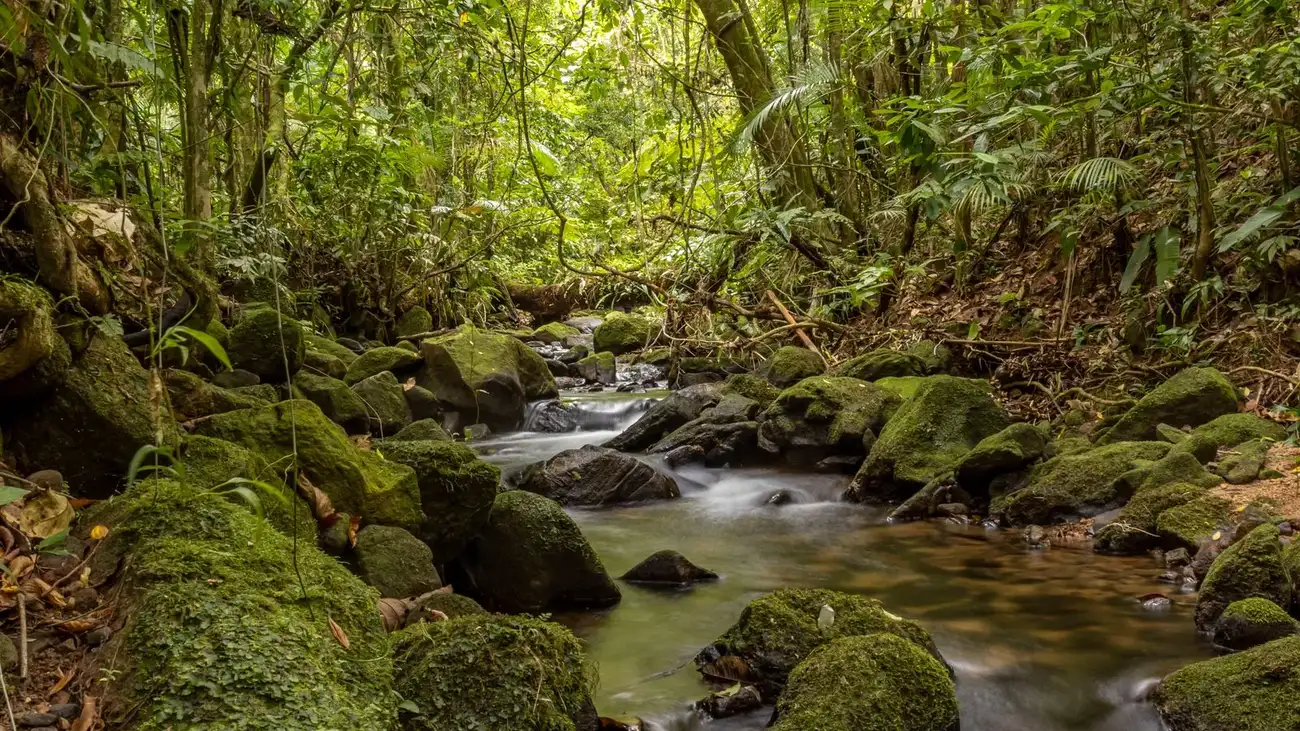
REDD+ (Reducing Emissions from Deforestation and Forest Degradation) is a framework under the United Nations Framework Convention on Climate Change (UNFCCC) that creates financial incentives for developing countries to keep their forests standing. The “+” covers conservation of forest carbon stocks, sustainable management of forests, and enhancement of forest carbon stocks. In the voluntary carbon market, REDD+ is also a project category that generates carbon credits by demonstrating that a specific area of forest would have been cleared or degraded without the project’s intervention.
How REDD+ works in practice
A REDD+ project starts with a defined area of forest that faces a credible threat of deforestation or degradation. The project proponent (which can be a private company, an NGO, a community organization, or a government entity) must establish a baseline scenario: what would happen to that forest in the absence of the project. The difference between the emissions in the baseline scenario and the emissions with the project in place determines how many carbon credits the project can issue.
Each credit represents one metric tonne of CO2 equivalent that was kept out of the atmosphere. These credits are then verified by an independent third-party auditor against a recognized standard, most commonly Verra’s Verified Carbon Standard (VCS), and can be sold on the voluntary carbon market.
Consider a concrete example. A landowner in a tropical region holds title to 50,000 hectares of forest surrounded by cattle ranching operations. Historical deforestation data for the surrounding area shows a consistent pattern of land clearing. The project proponent documents this threat, implements activities to prevent clearing (patrols, fire management, livelihood programs for local communities), and registers the project under a carbon standard. After verification, the project issues credits each year based on the measured difference between what the forest stores and what the baseline projected would remain.
The five activities under the “+”
- Reducing emissions from deforestation
- Reducing emissions from forest degradation
- Conservation of forest carbon stocks
- Sustainable management of forests
- Enhancement of forest carbon stocks (for example, through reforestation or assisted natural regeneration within the project area)
Not every REDD+ project covers all five activities. Most projects in the voluntary market focus on avoided deforestation (the first activity), which is the most straightforward to measure against a counterfactual baseline.
REDD+ in Brazil
Brazil holds the largest area of tropical forest in the world and is, by volume, one of the largest sources of REDD+ credits globally. The country’s legal and institutional framework adds specific layers that international professionals dealing with Brazilian operations need to understand.
At the federal level, Brazil’s National REDD+ Strategy (ENREDD+) provides the policy framework. The strategy is coordinated by the Ministry of the Environment and linked to Brazil’s commitments under the Paris Agreement. Brazil also operates the Amazon Fund (Fundo Amazônia), managed by BNDES, which receives results-based payments for demonstrated reductions in deforestation, though the Amazon Fund itself does not issue tradable carbon credits.
For voluntary market REDD+ projects in Brazil, land tenure documentation is a critical requirement. Projects must demonstrate clear legal rights over the forest area, which in practice means navigating the Rural Environmental Registry (CAR, Cadastro Ambiental Rural) and, in many cases, overlapping claims involving indigenous territories, conservation units, or settlement areas. The Brazilian Forest Code (Law 12.651/2012) sets the legal requirements for forest preservation on private land (the Legal Reserve and Permanent Preservation Areas), and any REDD+ project must show that the credited emission reductions go beyond what the law already requires.
Several Brazilian states have developed their own jurisdictional REDD+ programs. Acre, Mato Grosso, and Amazonas have been notable in creating state-level frameworks that attempt to nest private REDD+ projects within broader jurisdictional accounting, aiming to avoid double counting between project-level and state-level claims.
Why baselines matter (and why they cause controversy)
The entire logic of REDD+ depends on a counterfactual: what would have happened without the project. This baseline is, by definition, a projection rather than an observed fact. A project that sets an inflated baseline (projecting more deforestation than would realistically occur) will generate more credits than the actual climate benefit justifies. This is the single most debated aspect of REDD+ credit quality.
Several high-profile investigations have examined whether REDD+ projects overstated their baselines. In response, Verra revised its methodology for REDD+ projects, moving toward jurisdictional baselines that use regional deforestation data rather than project-specific projections. This shift aims to make baselines harder to inflate, though it also changes the economics for individual projects.
When buyers evaluate REDD+ credits, the baseline methodology and the project’s third-party rating (from agencies such as Sylvera, BeZero Carbon, or Calyx Global) are among the first things examined. A low rating on additionality or over-crediting risk directly compresses the price a credit can command.
The most common confusion
REDD+ is frequently confused with reforestation or afforestation projects (often called ARR, Afforestation, Reforestation, and Revegetation). The distinction is fundamental. REDD+ protects existing forest that is under threat, while ARR projects plant new trees or restore forest on land that was previously cleared. They address different parts of the carbon cycle, use different methodologies, and carry different risk profiles. A REDD+ credit represents emissions that were avoided; an ARR credit represents carbon that was actively removed from the atmosphere.
Another common confusion involves the difference between voluntary market REDD+ projects (registered under standards like VCS) and jurisdictional REDD+ under the UNFCCC (where national or subnational governments receive results-based payments). These operate under different rules, different verification processes, and different buyers. A corporate buyer retiring credits for a net-zero claim is typically dealing with voluntary market REDD+ credits, not with sovereign-level UNFCCC payments.
Primary sources: Paris Agreement, official text (United Nations Treaty Collection, 2015); VM0048 Reducing Emissions from Deforestation and Forest Degradation v1.0 (Verra, 2023); Amazon Fund overview (Fundo Amazônia/BNDES, 2008).
There is no newsletter yet. Leave your email and you will hear first on the day there is one.