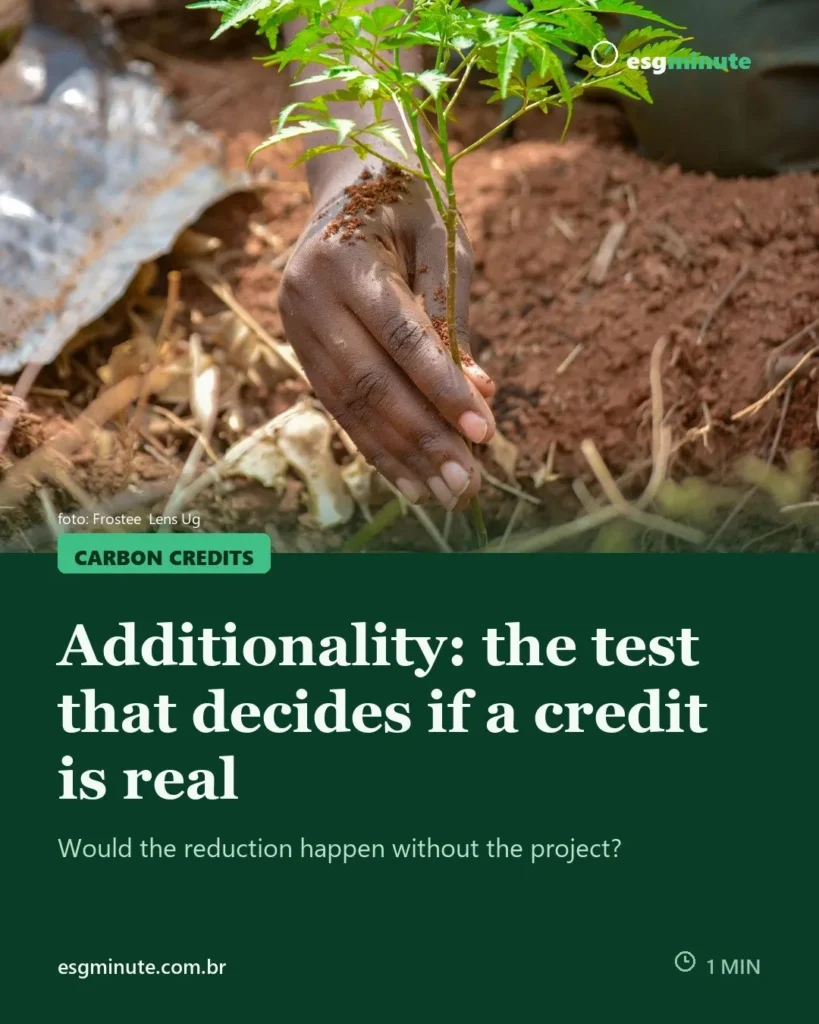
The minute
- Additionality means the emissions reduction would not happen in the baseline scenario, without the project
- It is the market’s most contested criterion, because the counterfactual scenario is never 100% observable
- Projects with lower risk of failing this test (like certain biogas and HVO projects) tend to cost more
Why it matters: A credit without real additionality represents no true reduction, and it is the leading cause of scandals and retracted reporting in the voluntary market.
What additionality actually asks
The question behind additionality is deceptively simple: would this emissions reduction have happened anyway? If a factory was already planning to switch from coal to natural gas for economic reasons, selling carbon credits for that switch does not represent a new reduction. The credit buyer pays for something the atmosphere was going to get for free. When that happens at scale, corporate net-zero claims built on those credits collapse under scrutiny, and the market’s credibility erodes with them.
How it is tested
A project developer must show a financial, technological or regulatory barrier that, without credit revenue, would stop the project from happening. Methodologies from Verra and Gold Standard require this analysis before approving a project.
In practice, the test follows a sequence. First, the developer identifies alternative scenarios: what would happen on the same land or in the same facility without the project. Second, the developer runs a barrier analysis, demonstrating that at least one barrier (investment cost, access to technology, or absence of a legal mandate) prevents the project from proceeding on its own. Third, a common-practice analysis checks whether similar activities are already widespread in the region. If dozens of comparable projects already operate without credit revenue, the case for additionality weakens. Finally, an independent auditor (called a validation and verification body, or VVB) reviews all of this documentation before the registry issues any credits.
Where the test breaks down
In REDD+ (forest conservation), the avoided deforestation scenario is a projection, not an observed fact, and that is where investigative journalism has most questioned credits in recent years. The developer must estimate how much forest would have been cleared over the crediting period, then claim credit for the difference between that projection and what actually happened. If the baseline overstates deforestation risk, the project generates more credits than the real reduction warrants. Several large-scale investigations have argued that exactly this pattern occurred in major REDD+ programmes, leading registries to revise their baseline methodologies.
Renewable energy projects in middle-income countries face a different version of the same problem. As solar and wind costs have dropped, grid-connected projects in many regions are now commercially viable without credit revenue. Registries have responded by tightening eligibility rules for grid renewables, but the question of where the viability line sits in each country remains contentious.
The most common mistake buyers make
The most frequent error is treating registry approval as a guarantee of additionality. Registry approval means the project passed the methodology’s tests at the time of validation. It does not mean the baseline assumptions will hold for the entire crediting period, which can span twenty years or more. Conditions change: a government may introduce a regulation that mandates the same activity, or the economics of the technology may shift so that the project becomes profitable on its own. When that happens, credits issued after the change may no longer represent additional reductions, even though the registry has not yet reassessed the project.
Additionality under Brazil’s national framework
Brazil’s regulated carbon market legislation (approved by the federal congress and signed into law) created the Brazilian Emissions Trading System (SBCE), governed by the Interministerial Committee on Climate Change (CIM), a managing body designated by the federal government and a permanent technical advisory committee. Within this framework, offset credits used for compliance must meet additionality requirements defined by the national authority. For REDD+ projects in the Amazon and other biomes, this means the baseline deforestation scenario must align with official government data on historical deforestation rates, rather than relying solely on the developer’s own projections. In practice, operators in Brazil face an additional layer: the project must demonstrate that it would not have occurred under existing environmental law, including the Forest Code, which already requires landowners to maintain a percentage of native vegetation. A project that merely enforces an existing legal obligation does not pass the additionality test. This distinction has practical consequences, because a significant share of forest conservation in Brazil is already mandated by law, narrowing the window for what qualifies as additional.
What is changing risk perception
Independent project ratings, now used by marketplaces and third-party assessors, try to capture additionality risk in a single score, which feeds directly into the price per tonne. These ratings evaluate the methodology’s robustness, the baseline’s conservatism, and the project’s financial dependence on credit revenue. Projects with high additionality ratings can command prices several times higher than projects with weak or unrated additionality. This price differentiation creates a financial incentive for developers to invest in stronger documentation and more conservative baselines.
What is still unresolved
Two structural questions remain open. The first is how to handle additionality over time. A project that was clearly additional at launch may cease to be additional five or ten years later if market conditions or regulations change. Most methodologies do not require continuous reassessment on a short cycle, which means some portion of credits in circulation may represent reductions that would now happen without project support. The second question is jurisdictional crediting: when a national or subnational government claims credit for an entire region’s emissions trajectory, how do you separate the contribution of individual projects from broader policy effects? Article 6 of the Paris Agreement engages this question through corresponding adjustments, but the operational rules are still being refined in ongoing climate negotiations.
Frequently asked questions
Do all forest projects have additionality problems?
No, but it is the most scrutinised category, because the deforestation baseline is harder to prove than for other technologies.
How should a buyer assess this?
Look at the project’s independent rating, if one exists, and the registry’s history of retractions or methodology corrections.
Whose rule is additionality?
Verra, Gold Standard and other registries each have their own rules, but the underlying principle is the same across all of them.
Can a project lose its additionality status after issuance?
Registries can suspend or cancel methodologies, and some have done so. When that happens, previously issued credits may remain valid but future issuance stops, and buyers who hold those credits face reputational risk.
Read next: what a carbon credit is.
Read next: the checklist before you buy.
Primary sources: The Core Carbon Principles (ICVCM, 2023); VT0009 Combined Baseline and Additionality Assessment, v1.0 (Verra, 2024); Law 15,042/2024 creating the SBCE, official text in Portuguese (Presidency of Brazil, 2024); Forest Code, Law 12,651/2012, official text in Portuguese (Presidency of Brazil, 2012).
There is no newsletter yet. Leave your email and you will hear first on the day there is one.