The minute
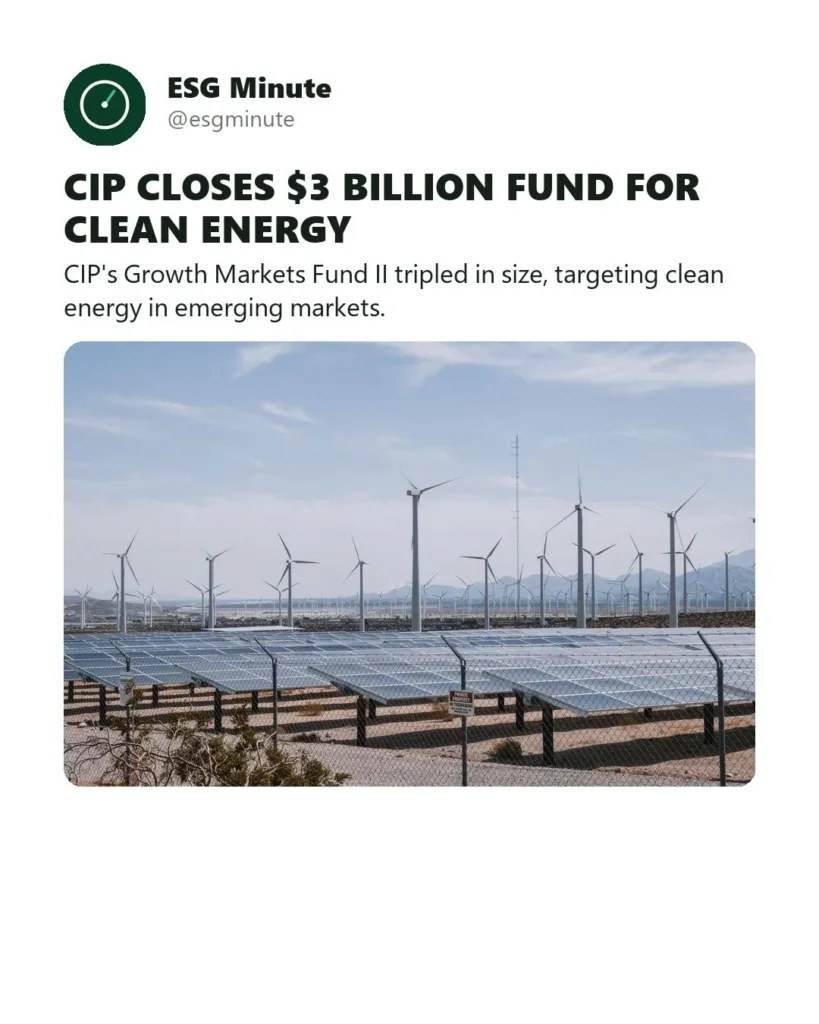
- Copenhagen Infrastructure Partners closed its Growth Markets Fund II at $3 billion, three times the size of its predecessor fund
- The fund targets renewable energy infrastructure across roughly 15 emerging markets in Eastern Europe, Asia and Latin America
- It has already committed $1.6 billion across nine investments, including battery storage and solar projects
Why it matters: A fund of this size dedicated specifically to emerging markets signals that institutional climate capital is starting to look past the usual US and Europe-heavy renewable portfolios, betting that emerging-market clean energy build-out is now investable at scale, not just a development-finance afterthought. Growth Markets Fund II’s size, three times its predecessor, suggests investor demand for this strategy outpaced the fund manager’s own expectations when it first raised capital for the space.
Where the money is going
GMF II focuses on large-scale, complex greenfield energy infrastructure projects. That means the fund finances assets that do not yet exist (new solar farms, new battery facilities) rather than buying operating plants on the secondary market. CIP has named five of the 15 target markets: India, Vietnam, the Philippines, Mexico and South Africa. The selection criteria, according to CIP, combine high economic and demographic growth with an expanding middle class, which together create rising electricity demand and a structural need for new generation capacity.
Among the nine investments already committed, three stand out for what they reveal about the fund’s scope. One is described as the largest standalone battery storage project in Chile. Another is Mexico’s first large-scale solar and battery storage project, pairing generation with dispatchable storage in a market that has historically relied on natural gas. The third is Pestera II, one of the largest renewable energy investments in Romania, showing that the fund’s definition of “emerging” extends into EU member states with less mature clean energy sectors.
What the predecessor fund delivered
GMF I closed in 2019 at $1 billion and concentrated on India and South Africa. CIP expects it to deliver approximately 8.7 GW of energy across more than 50 projects in those two countries. That track record matters because it gave limited partners (the institutional investors who commit capital to these funds) a concrete reference point. A threefold increase in fund size, from $1 billion to $3 billion, with the same management team is unusual in infrastructure private equity and typically reflects both strong returns from the prior vintage and unmet allocator demand for the strategy.
Niels Holst, Partner and Co-Head of Growth Markets Funds at CIP, framed the final close as “a strong validation of our Growth Markets strategy and of investors’ confidence in our ability to originate, develop, and build large-scale renewable energy projects.” Ole Kjems Sørensen, who shares the co-head role, added that the fund aims to “connect capital with high-quality renewable energy projects in select Growth Markets that have a fundamental need for new and reliable energy infrastructure.”
How a greenfield infrastructure fund works in practice
For operators and developers in target countries, a fund like GMF II typically enters during the early development stage: the sponsor identifies a site, secures land rights and grid connection agreements, obtains environmental permits, and negotiates a power purchase agreement (PPA) with a local utility or corporate off-taker. The fund provides equity capital to finance construction, often alongside local or international project debt. Once the asset is built and operating, returns come from long-term contracted cash flows under the PPA. The greenfield approach carries more development risk than buying an operating plant, but it also allows the fund to capture the full value created during construction, which is why returns in greenfield infrastructure tend to exceed those in secondary transactions.
Brazil and the Latin American pipeline
CIP has not publicly confirmed whether Brazil is among the 15 target markets, but the fund’s Latin American scope (it already has projects in Chile and Mexico) makes Brazil a relevant reference point. Brazil’s electricity regulator, ANEEL (Agência Nacional de Energia Elétrica), runs periodic regulated energy auctions that contract new generation capacity years in advance. These auctions have been a primary channel for private capital entering Brazilian renewables, because the long-term contracts they produce reduce revenue uncertainty for investors. Any infrastructure fund looking at Latin American clean energy at scale would need to understand this auction mechanism and the regulatory calendar that governs it. Whether GMF II participates in future Brazilian auctions, or enters through bilateral corporate PPAs outside the regulated market, remains to be seen.
The common mistake: treating emerging markets as one block
The most frequent error investors and operators make when deploying capital across 15 different countries is assuming that a structure that works in one jurisdiction transfers cleanly to another. Land tenure rules, grid interconnection timelines, permitting processes, currency controls and tax incentives vary not just between regions but between neighboring countries. GMF I’s concentration in only two markets (India and South Africa) simplified that problem. GMF II’s expansion to 15 markets means the fund must maintain country-specific legal, regulatory and construction expertise across a much wider footprint, and the cost and complexity of doing so is a real operational risk that fund size alone does not solve.
What is still unresolved
Three open questions will determine how much of GMF II’s $3 billion translates into built megawatts. First, grid infrastructure in many target countries lags behind generation capacity, and curtailment (forcing a solar or wind farm to reduce output because the grid cannot absorb it) can erode project economics. Second, currency risk is inherent in funds that raise dollars but earn revenue in local currencies; hedging strategies exist but add cost. Third, several of the named markets (the Philippines, Vietnam, Romania) are in the middle of regulatory transitions that could change the terms under which new projects are permitted and compensated. The fund launched in 2023 and reached final close in 2026, meaning the remaining $1.4 billion in uncommitted capital will be deployed into a regulatory environment that may look different from the one underwritten at launch.
via ESG Today
Primary source: Copenhagen Infrastructure Partners, Growth Markets Fund II closes at USD 3 billion (GlobeNewswire, 14 Aug 2026).
Primary source: Copenhagen Infrastructure Partners, Growth Markets Fund II closes at USD 3 billion (GlobeNewswire, 14 Aug 2026).
There is no newsletter yet. Leave your email and you will hear first on the day there is one.